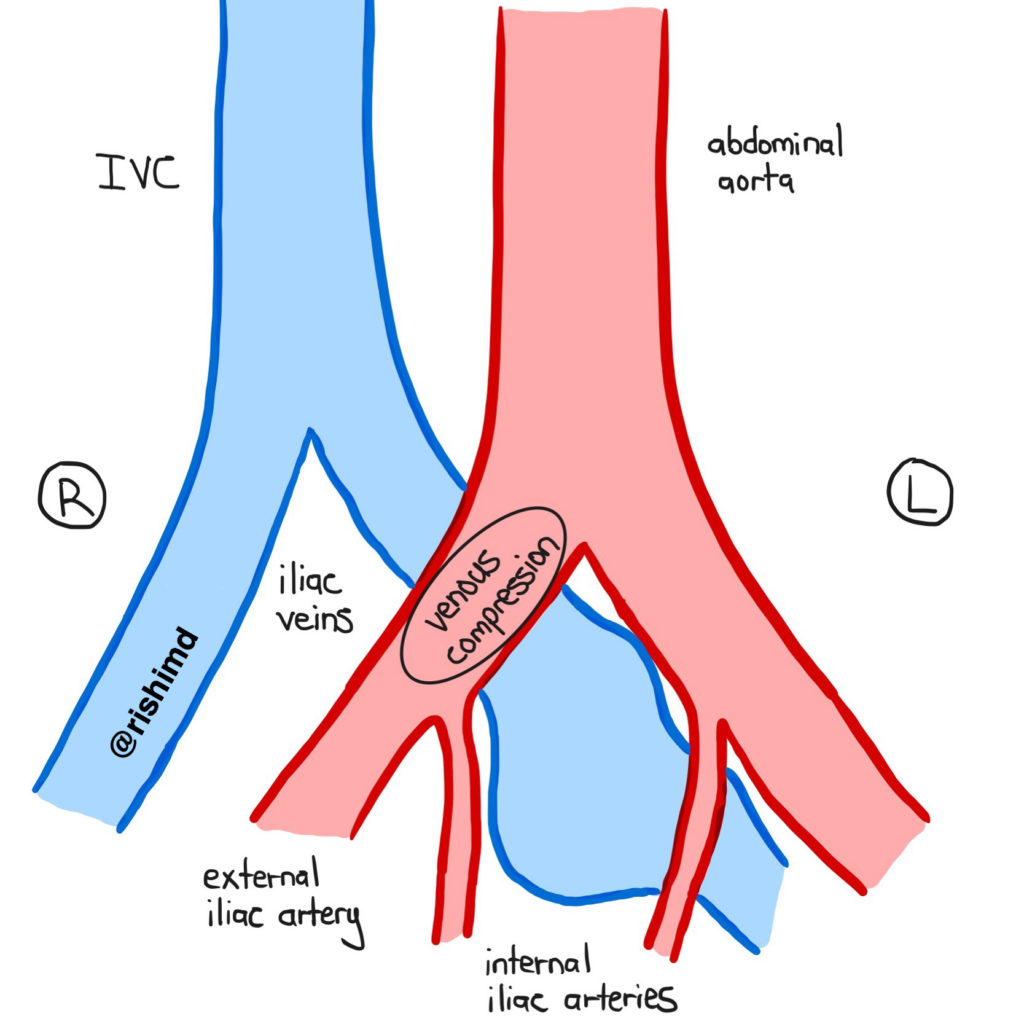
MTS, or May-Thurner Syndrome, is another major abdominal vascular compression syndrome. MTS occurs when the left iliac vein is compressed by the right iliac artery. The cause of the compression is an anatomical abnormality when the right iliac artery rests on the left iliac vein. The compression of the left iliac vein causes pressure to build up and blood to flow abnormally in this vein and throughout the pelvis leading to symptoms.
The symptoms of MTS are left leg pain and swelling, pelvic pain, enlarged veins in the left leg, and leg pain when walking. MTS can also lead to a DVT, or deep vein thrombosis, which can cause additional symptoms including tenderness and throbbing in the leg, redness, or heaviness in the leg.
MTS can be diagnosed through a CT scan, an ultrasound, a venogram, or an intravascular ultrasound. A CT scan can show the compression of the left iliac vein and narrowing of the vein. An ultrasound is imaging that can show narrowing of the left iliac vein, in addition to being able to detect abnormal blood flow in the vein. A venogram, where dye is injected into the veins, can allow a radiologist to capture images of the vein to detect a compression. Lastly, an intravascular ultrasound can capture internal images of the vein and show the compression.
The treatment for MTS is surgery. There are multiple surgical options. The first option is an extravascular stent where a stent is placed outside of the vein. An endovascular stent, which is placed inside of the vein, can also be placed to fix the compression. Lastly, the right iliac artery can be repositioned to remove the pressure it is placing on the left iliac vein.
 Kate's Courage
So sorry to hear about all of your medical problems. Hope Drs. Can get u back to normal soon.
Our prayers r with u.
LikeLike