January was the first time I began to learn about Abdominal Vascular Compressions Syndromes. After my pediatrician mentioned a condition called Superior Mesenteric Artery Syndrome (SMAS), a rare condition that causes an inability to eat or drink without pain and nausea, I began to do hours of research on these rare syndromes. I also found a condition called Median Arcuate Ligament Syndrome (MALS), a condition that perfectly lined up with my strange symptoms. It can cause painful hiccups, extreme pain with NG tubes, and severe fatigue after eating, all bizarre symptoms I was dealing with. I began to strongly suspect that at least one of these syndromes was the root cause of my illness.
My mom and I mentioned these conditions to my GI doctor, hopeful that he would say they were a possibility that we could further explore, but he said that they had been eliminated as the cause back in September and October with my ultrasound and CT. I was heartbroken once again, certain that despite the lack of radiological evidence, I had these conditions.
By this time, my GI doctor mentioned a new type of feeding tube to attempt to aid my lack of nutrition and hydration. After a weekend of consuming eight ounces of water and under 1000 calories, I agreed to the tube. This time I would be getting a nasojejunal tube, or NJ tube. NJ tubes are similar in appearance to NG tubes, but they are longer as they go through the nose, down the throat, through the stomach, and into the small intestine. This type of tube requires sedation and a series of X-Rays to be properly placed into the small intestine.
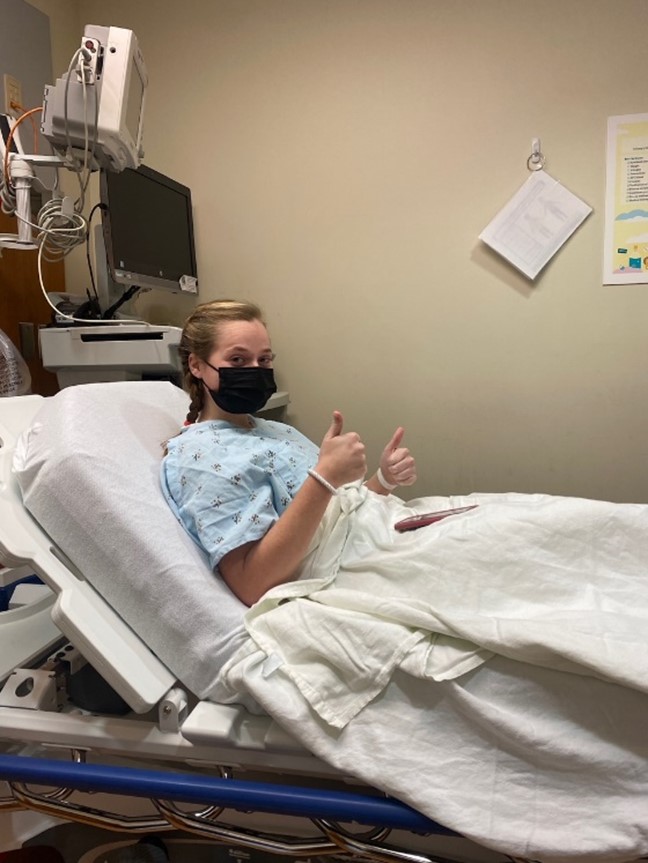
After my procedure, I was admitted to the hospital to monitor for refeeding syndrome and to see if I would tolerate this tube. Luckily, I did. The NJ tube caused some nausea and uncomfortable bloating, but I was able to tolerate a rate of 100 ml/hour without any of the extreme pain that eating by mouth caused. I finally had a source of nutrition, but still no answers as to what was causing my symptoms. However, the tolerance of the NJ tube did allow us to identify that my stomach was in fact the organ causing pain, since the new tube bypassed my stomach.
After a few days in the hospital, I returned home. Despite having a source of nutrition, I was miserable. I didn’t want to see anyone with the tube taped to my face and was endlessly frustrated with the lack of answers. That is when my mom received a call from a doctor in Connecticut. He was an expert in Median Arcuate Ligament Syndrome that she had sent my records to, and he was willing to see me.
So, on January 24, my parents and I flew to Connecticut to meet with the expert on the condition I was convinced I had. He first completed an ultrasound, which gave us a key piece of information. My pain was located directly on top of my celiac artery and celiac plexus nerves, the area that is impacted by Median Arcuate Ligament Syndrome. He also reviewed my CT scan from October and confirmed that I had the anatomy required to have MALS, which is a low-lying diaphragm.
The surgeon needed one last test completed to confirm my diagnosis of Median Arcuate Ligament Syndrome: a celiac plexus nerve block. For this block, an interventional radiologist goes in through the back with two large needles and injects a numbing medication in the celiac plexus nerve bundle. If this procedure takes away the pain for at least 4 hours, the diagnosis of Median Arcuate Ligament Syndrome is confirmed, and surgery is the next step. I left Connecticut with a plan to coordinate with my pain doctor to schedule a nerve block and a feeling that I hadn’t had in months… I felt hope.
 Kate's Courage