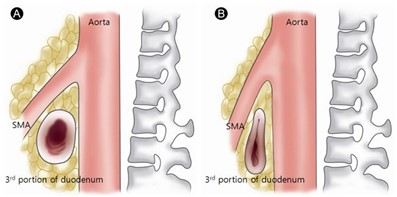
SMAS, or Superior Mesenteric Artery Syndrome, is another one of the major abdominal vascular compression syndromes. SMAS occurs when the fat pad surrounding the superior mesenteric artery is lost, causing the artery to compress part of the small intestine, called the duodenum. This then causes a compression of the intestine and prevents food and drink from passing through as they should. SMAS is most often caused by major, rapid weight loss from abdominal surgery, illness, or other abdominal vascular compressions.
The symptoms of SMAS include abdominal pain after eating or drinking, nausea, vomiting, heartburn, feeling full quickly, bloating, and weight loss.
Like MALS, SMAS is difficult to diagnose and is often a diagnosis of exclusion that is only found after all other causes have been eliminated. SMAS is most commonly diagnosed through ultrasound, CT, endoscopy, or Upper GI series. On an ultrasound, it can be diagnosed by measuring the angle of the superior mesenteric artery. Ff the angle is too small, then the fat pad has been lost. SMAS can also be seen on a CT to see if the intestine is being compressed. An endoscopy can diagnose SMAS by seeing if the intestine narrows in the third section of the duodenum, around the area of the superior mesenteric artery. Lastly, SMAS can be diagnosed through an Upper GI series. In this test, the patient will drink a chalky drink of barium and will have a series of images taken on X-Ray. This allows doctors to see the drink can pass through the digestive system. If the liquid slows down and stops at the location of the superior mesenteric artery, then there is evidence of a blockage in the intestine caused by SMAS.
SMAS can be treated by either weight gain or surgery. It is possible for SMAS to be reversed when the patient gains weight and regains the fat pad around the superior mesenteric artery. However, there is no guarantee that even with large weight gain that the fat pad will be regained, so many people decide to treat it surgically. During surgery, there are a few different ways to treat SMAS. One way is called a Ladd’s procedure. During a Ladd’s procedure, the intestines are moved out from under the superior mesenteric artery and are sutured into a new location where they cannot be compressed. This procedure requires for all the small and large intestines to be moved in order to make room away from the compression. Another surgical option is called a DDJ. During a DDJ, the portion of the intestine that has been compressed is bypassed by connecting a portion of the intestine below the compression directly to the stomach. This creates a new path for food and drink from the stomach to the small intestine.
 Kate's Courage