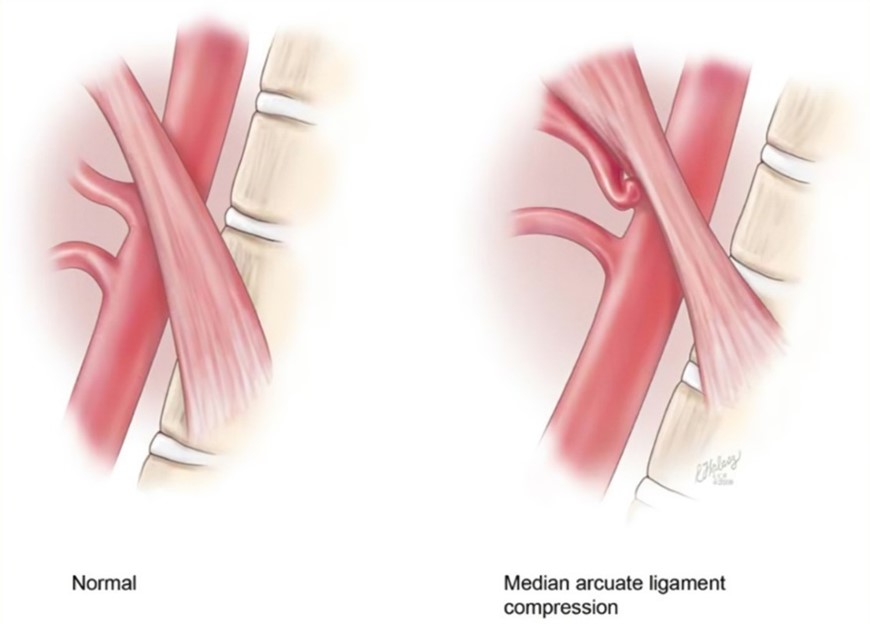
MALS, or Median Arcuate Ligament Syndrome, is one of the major abdominal vascular compression syndromes. It occurs when there is a low-lying diaphragm, and the median arcuate ligament, which is the band at the bottom of the diaphragm, sits too low on top of the celiac artery and its nerves. This is an anatomical abnormality that people are born with or obtain from trauma to the abdomen. The celiac artery and the celiac plexus nerves supply blood flow and sensation to stomach, spleen, liver, pancreas, and other major organs in the upper GI system. When the artery and nerves are compressed, as in the case of MALS, blood flow and sensation to these organs are compromised which leads to many life-altering symptoms.
The symptoms of MALS include pain with eating and drinking, fatigue after eating, belching, hiccupping, exercise intolerance, abdominal tenderness, nausea, and weight loss.
In addition to causing horrible symptoms, MALS is extremely difficult to diagnose. It is often only found after months or even years of searching for answers and excluding other possible causes of symptoms. The two most common ways to diagnose MALS are a doppler ultrasound and a CTA. The doppler ultrasound is used to measure the velocity of the blood flow through the celiac artery while inhaling and exhaling. In people with MALS, the velocity through the artery will be higher than normal during the exhale to get more blood through the narrowed artery. MALS can also be seen on a CTA, where the artery may be narrowed or possibly show a hook shape where the artery is being pulled down by the median arcuate ligament. In order to ensure that surgery has the possibility to treat the MALS symptoms, a special nerve block called a celiac plexus block can be completed. This block numbs the nerves around the celiac artery, and if the block allows the patient to eat and drink without pain for a few hours, surgery has the possibility to fix MALS pain and symptoms.
The only way to correct MALS is surgery. The surgery can be completed laparoscopically, robotically, or open. During the surgery, the surgeon will release the ligament off the nerves and artery to restore normal blood flow, and trim back the damaged nerves. Some surgeons also trim the diaphragm up to position it to where it should be, which prevents MALS symptoms from relapsing.
 Kate's Courage